
Prof. Dr. Anabelle Kriznar
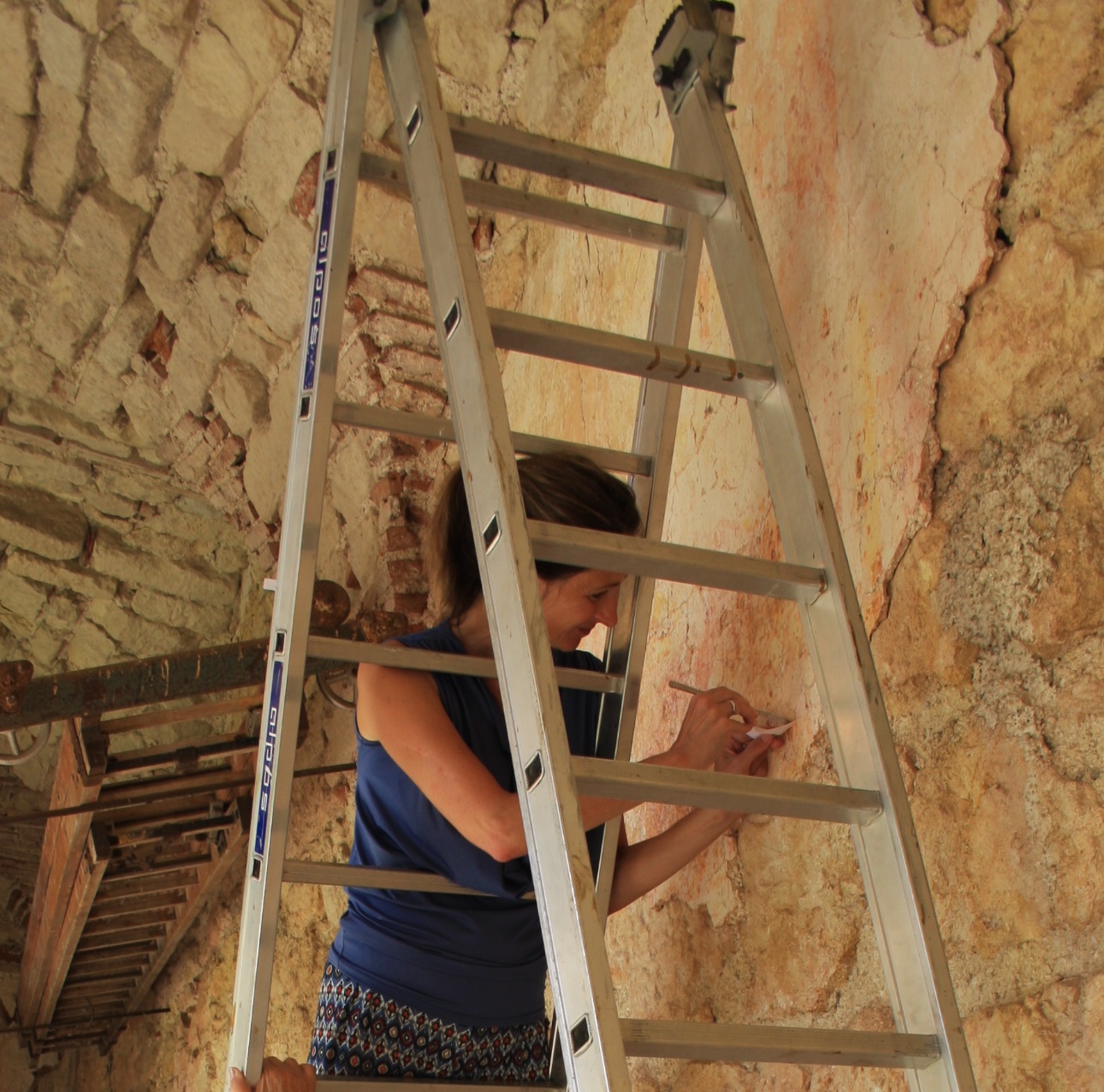
Foto: Privat
Fellow
Alexander von Humboldt-Stiftung
Raum 3.01
Tel.: 030.2093-66236
Fax: 030.2093-66204
anabelle.kriznar@hu-berlin.de
Short CV
Art historian dedicated to analysis of artworks (PhD in Art History, Faculty of Arts, University of Ljubljana, Slovenia), specialising in materials and techniques of medieval mural paintings. She is assistant professor at the University of Seville (Faculty of Fine Arts), as well as a Senior Research Fellow at the University of Ljubljana (Faculty of Arts). She specialised through several international courses on artistic materials and analytical techniques and carried out analytical work in museums, restoration workshops and churches in different European countries (Slovenia, Spain, Germany, England, Italy, Austria, Slovakia, Hungary, Croatia), being a guest researcher in institutions as The British Museum (London), Opificio delle Pietre Dure (Florence), Bundesanstalt für Materialforschung- und prüffung (Berlin), among others. Some of these stays were sponsored by recognised scholarships including one awarded by the Alexander von Humboldt Foundation. Dr. Kriznar is an ICOM, ICOMOS (Spain and Slovenia), IIC and Slovene art-history Association member, as well a member of different research groups. She participates in several research projects, has presented results in many national and international conferences, has published two books, several book chapters and has authored more than 60 scientific articles.
Research project
The present research project, carried out at the Institute für Kunst und Bildgeschichte, is dedicated to the analysis of selected mural paintings from around 1400, located in the wider area that today spans the territories of Slovenia, Croatia, Austria, Slovakia, and Hungary. In the Middle Ages, this region was a crossroad of political, social, as well as cultural and artistic influences. All these mural cycles have been studied from the art-historical perspective, establishing workshop connections; however, they can also reveal significant differences in their execution. Therefore, material and technical analysis are being caried out on the basis of in situ study and the examination of tiny extracted samples of the support and colour layers, using various instrumental techniques (OM, SEM-EDX, XRF, XRD, Raman spectroscopy, FTIR). The results will provide new insights into the selection of materials (plaster, pigments, binders) by the artists and their technical skills, with the aim of confirming or reassesing the art-historical attributions and to improving our understanding of technical procedures and influences in this region around 1400.